Loading Table of Contents...
What is an SEO-friendly website? 10 criteria before you build
What is an SEO-friendly website? Explore 10 criteria for technology, structure, content, speed, and mobile to build an effective SEO foundation.
An SEO-friendly website is built with a structure, technical foundation, and content that help search engines access, understand, and index its pages while providing a good user experience. SEO-friendly design creates a foundation for growing organic traffic, but it does not guarantee top rankings on Google.
Connect Tech explains what an SEO-friendly website is, examines 10 important criteria, shows you how to check them, and outlines the requirements businesses should discuss with a website design company.
What is an SEO-friendly website?
An SEO-friendly website combines search engine accessibility, a clear structure, useful content, and a good user experience to support long-term SEO.
Meeting SEO requirements involves more than code. It brings technical SEO, on-page SEO, content, information architecture, and UX together in one coherent system. Website structure helps users and bots find content, metadata describes page topics, internal links communicate relationships between URLs, and useful content helps pages meet search needs.
Businesses should therefore avoid treating “SEO-friendly” as a Google certification, because Google does not issue an official certification label for this concept.
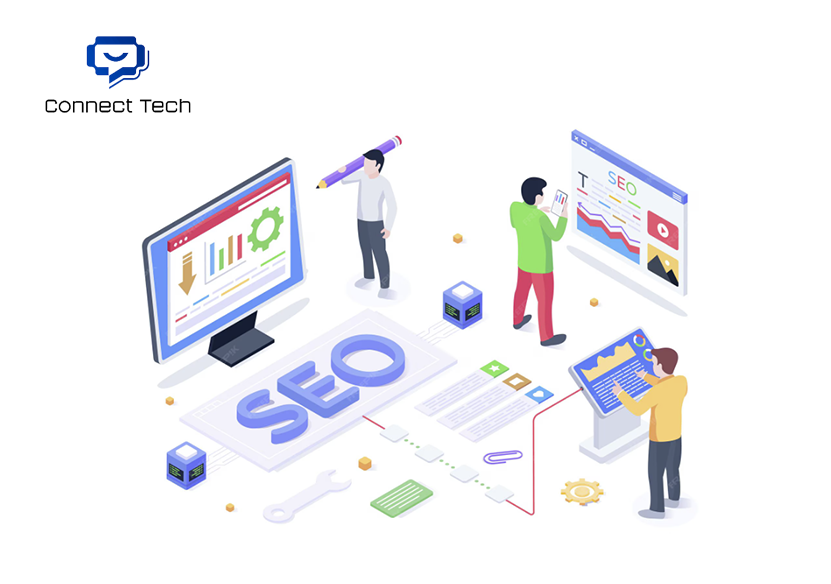
Criteria for evaluating an SEO-friendly website
The following 10 criteria focus on factors that directly affect crawling, indexing, content understanding, user experience, and the website's potential for SEO growth.
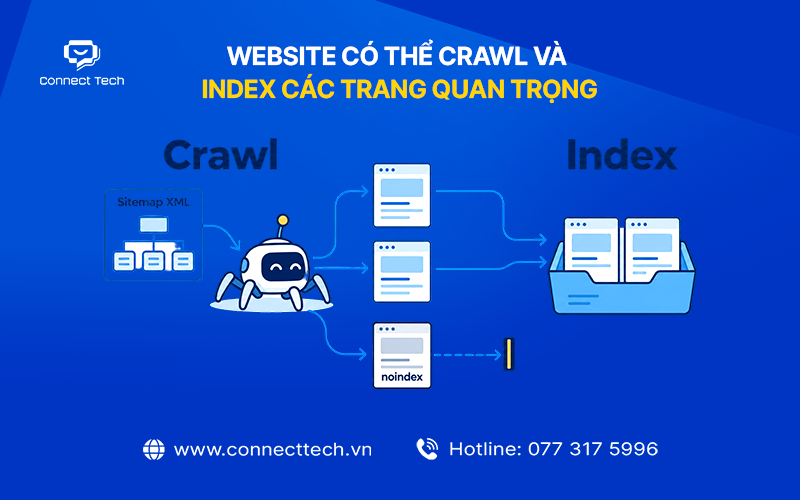
Important pages can be crawled and indexed
Crawlability and indexability determine whether search engines can discover a website's important content and include it in their search index.
Googlebot needs access to URLs intended to appear on Google, while robots.txt can control crawling at the directory or URL level. An XML sitemap helps Google discover important URLs more efficiently, and a noindex directive can tell search engines not to include a page in their index.
Businesses need to distinguish crawlability from indexability: a crawler may be able to access a URL even if that URL is not indexed.
Clear website structure and easy navigation
A clear website structure helps users find information faster and helps search engines understand relationships between pages.
Organize content in a logical hierarchy, with understandable menus, appropriate categories, contextual internal links, and breadcrumbs where needed. Google also recommends crawlable links and a logical URL structure to support content discovery.
A good structure allows businesses to add products, services, or articles without creating confusing navigation.
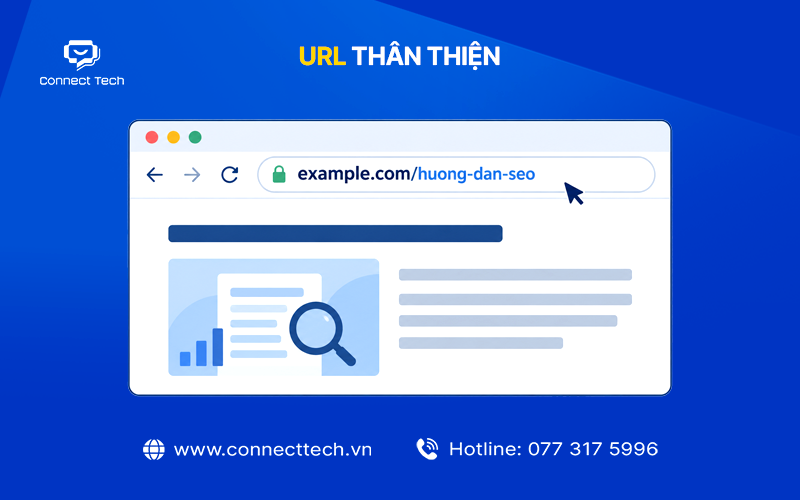
User-friendly URLs
User-friendly URLs help users and search engines recognize a page's topic before opening it.
Use concise, readable, consistent URLs that reflect the page's actual content. URLs do not need keywords at all costs, because Google does not require businesses to include a keyword in every URL.
When choosing names for an SEO-friendly website, businesses should also distinguish their brand name from individual page URLs, since branding and URL structure serve different purposes.
Proper management of titles, meta descriptions, and headings
Titles and meta descriptions help search engines understand a page's topic and help users judge a search result's relevance before visiting.
Each important page should have its own title and meta description, while H1, H2, and H3 headings should reflect the organization of the information. Google recommends descriptive, useful titles and meta descriptions that match the content rather than contain stuffed keywords.
Responsive design and good mobile usability
Responsive design adapts the interface to different screen sizes and provides a consistent experience across desktops, tablets, and smartphones. Google uses the mobile version of a website for indexing and ranking, so businesses should not treat mobile as a secondary version.
Check menus, fonts, CTA buttons, forms, images, and content on small screens to make sure users can interact comfortably.
Good performance and Core Web Vitals
Website performance directly affects the user experience, especially on mobile devices or unstable networks.
Core Web Vitals cover three metrics: LCP for the loading of the main content, INP for responsiveness to interactions, and CLS for layout stability. Businesses should monitor these metrics rather than rely solely on an overall score.
PageSpeed Insights and Google Search Console can help assess real-world performance and identify areas for improvement.
Optimized images
Optimized images reduce data transfer, improve the user experience, and help search engines understand visual content.
Use appropriate image dimensions, modern formats where possible, sensible compression, and alt text that accurately describes the image. Google also recommends placing high-quality images near relevant text so that users and search engines can understand their context.
HTTPS and an appropriate security foundation
HTTPS protects data transmitted between the browser and server and provides a necessary security foundation for a business website.
Use a valid SSL/TLS certificate and manage issues such as mixed content, protocol versions, administrator access, and system updates. Security alone does not make a website SEO-friendly, but inadequate security can put users and business operations at risk.
Useful content that meets search intent
Useful content addresses the needs users express through their search queries.
A good SEO article should do more than repeat keywords. It should answer questions, provide accurate information, be easy to read, and demonstrate relevant knowledge or experience. Google encourages people-first content and warns against producing large volumes of low-value content primarily to manipulate rankings.
Start with search intent, then develop the topic, outline, expert information, practical examples, and relevant CTAs instead of trying to include as many keywords as possible.
Structured data where appropriate
Structured data helps Google better understand the type of content a page provides and may make the website eligible for certain enhanced search appearances.
Schema.org provides a widely used vocabulary for structured data, but businesses should only implement schema types that match the actual content on the page. Structured data does not guarantee high rankings or the appearance of a rich result.
Why should businesses build an SEO-friendly website from the start?
Building an SEO-friendly website from the start helps reduce the cost of later fixes and creates a stronger foundation for content, organic traffic, and conversions.
Avoid restructuring the website when SEO begins
Designing an SEO-friendly website from the start limits the need for major changes when SEO work begins after launch.
An unplanned website may have inconsistent URLs, duplicate pages, categories that are difficult to expand, metadata that cannot be edited, or important pages that crawlers fail to discover. Addressing these problems can take more time and money once the amount of content has grown.
Create a foundation for content and organic traffic
Good website architecture lets a business expand its content by topic without disrupting existing URLs and navigation. Content marketing should therefore be considered during website planning, rather than only after the site is complete.
A strong foundation also supports the systematic development of landing pages, service pages, product pages, a blog, and topic clusters.
Connect SEO with user experience and conversions
An SEO-friendly website works best when SEO supports the user experience and is integrated with UX and conversion rate optimization (CRO). A page that loads quickly, works well on mobile, presents clear content, and offers logical navigation supports search visibility while helping customers take action.
Connect Tech believes a website should do more than serve as an “online business card.” It should become a digital platform connecting technology with marketing, operations, and business growth.

What should you consider for an SEO-friendly website in 2026?
In 2026, SEO still needs a strong technical foundation, but businesses should focus on useful content rather than tactics designed specifically for AI.
SEO fundamentals still matter for AI Search
SEO fundamentals remain important for AI Search because Google confirms that existing SEO principles continue to apply to AI Overviews and AI Mode. Google does not require a separate “AI SEO” toolkit, special files, or special schema to appear in these features.
Pages need to be indexed, have appropriate internal links, allow crawler access, and present important content in text so that search systems can process it.
Content should be clear, useful, and genuinely valuable
Business websites should demonstrate practical experience, provide accurate product or service information, clearly identify the author or responsible organization where appropriate, and update content when information changes. This approach aligns with Google's guidance on people-first content.
There is no need to chase separate “AI SEO tricks”
Businesses do not need to replace SEO fundamentals with formulas promoted as “AI SEO hacks” or “guaranteed ways to appear in AI Overviews.”
Google confirms that there are no special optimization requirements for AI Overviews or AI Mode. A sensible strategy remains building a technically sound website and developing quality content.

What should you require from an SEO-friendly website design company?
Evaluate a design company by its ability to build a foundation that supports operations and long-term SEO growth, rather than by the appearance of a demo alone.
Checklist before signing a contract
A technical checklist helps businesses define the handover scope and avoid receiving a finished website that is difficult to optimize for SEO later.
Ask the design company to confirm the following:
- Responsive design and mobile compatibility.
- Customizable URLs.
- Manageable titles, meta descriptions, and headings.
- An XML sitemap.
- Control over robots.txt.
- Support for canonical tags where needed.
- Manageable 301 redirects.
- Optimized images.
- Appropriate structured data implementation.
- Website performance testing.
- Manageable internal links.
- A CMS that supports content expansion.
- The ability to connect Google Search Console.
- Integration with Google Analytics or another measurement platform.
Questions to ask a website design company
Ask the development company directly about SEO management before signing a contract.
Important questions include:
- Can we edit page titles and meta descriptions?
- Does the website generate a sitemap automatically?
- Does it support redirect management?
- Can our team create landing pages independently?
- Do you optimize speed before handover?
- Does the website support structured data?
- Will the source code and data be handed over?
- Do you provide SEO support after launch?
These questions help businesses evaluate SEO-friendly website design from an operational perspective, beyond the appearance of the interface.
When should a business redesign its website?
Consider a redesign when the existing website clearly limits SEO, user experience, or business growth.
Common signs include:
- Slow loading that is difficult to improve.
- Poor mobile usability.
- A website structure that is difficult to expand.
- Inconsistent URLs.
- A CMS that does not allow control over metadata.
- Indexing problems affecting many URLs.
- Difficulty publishing new content.
- Difficulty connecting the website with marketing or measurement systems.
- Traffic that does not generate a proportionate level of conversions.
A business does not necessarily need to rebuild its entire website because of a few SEO issues. A technical audit before a redesign can identify which parts need fixing and which can be retained.

How has Connect Tech built an SEO-friendly website that drives conversions?
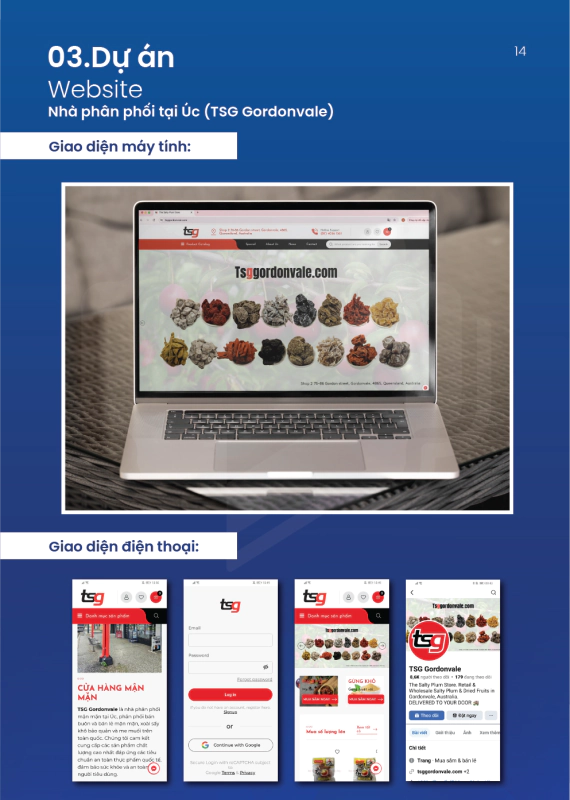
The Salty Plum Store by TSG Gordonvale demonstrates how an e-commerce website can combine technology development, performance, and SEO within a shared growth strategy.
Connect Tech developed a Laravel e-commerce system for TSG Gordonvale, integrated PayPal, Stripe, Australian shipping APIs, and eBay Australia, and implemented technical SEO alongside a multichannel marketing system. According to Connect Tech's case study, the website ranked first on Google Australia for strategic keywords related to Salty Plum, the Facebook page received more than 5 million views, and revenue grew fivefold.
An SEO-friendly website is a foundation that makes a site easier to find, understand, use, and expand; it is not a promise of rankings. By combining a technical foundation, useful content, UX, and business goals during the design stage, businesses create more opportunities for long-term SEO growth and conversions
Table of Contents
Related news

What is website redesign? What to know before rebuilding
Website redesign improves UX, SEO, speed, and conversions. Learn when to redesign, the process, costs, and how to preserve SEO when rebuilding your site.

What is an SEO-friendly website? 10 criteria before you build
What is an SEO-friendly website? Explore 10 criteria for technology, structure, content, speed, and mobile to build an effective SEO foundation.

What is UI? User Interface elements in website design
What is UI? Learn the elements of a website interface, how UI differs from UX, and how to check whether visitors can find information and submit inquiries.

What is UX? Its role and how to evaluate website experience
What is UX? Learn how visitors find information, use a website, and achieve their goals, with examples, UX vs. UI, and ways to assess the experience.

What is visual design? A foundation for better conversions
What is visual design? Learn the role of a visual designer and design and visualization fundamentals for better UX/UI and website conversions.
Standard website banner sizes for every screen
Learn standard website banner sizes for every device, plus safe zone rules, image optimization tips, and a technical SEO checklist.